CASE STUDY · OUR OWN SITE
How a brand-new domain with 7 backlinks reached Google's AI Overview in under 48 hours
We published one research article on 29 August 2026 on a domain with 7 referring domains and zero indexed blog articles. Google crawled it 90 minutes after we requested indexing, ranked it first for its target query within a day, and pulled it into the AI Overview source pool the same day. Over one morning the AI Overview regenerated three times and progressively adopted our finding.
- Subject
- GeoCited
- Observation window
- 29–30 August 2026 · Google Search Console, Ahrefs, live search from an Indian IP
Note on verification
Every number in this case study comes from Google Search Console for the property sc-domain:geocited.io, from Ahrefs, or from live checks of google.com run from an Indian IP on a logged-in Chrome profile. Timestamps are recorded where we have them and flagged where we do not.
Three things we could not control or verify. Our first AI Overview observation on 30 August has no precise timestamp, so the interval between the first and second observation is unknown. Localisation may affect results, since all checks ran from one country on one machine. And the page is days old, so nothing here should be read as a settled or repeatable result yet.
This is our own site, not a client's. We ran it on ourselves first because the claims are checkable and because we wanted to know whether the method worked before selling it.
The starting position
Everything below is from Google Search Console on 30 August 2026 unless noted.
| Signal | Value |
|---|---|
| Referring domains, Ahrefs | 7 |
| External links, Google Search Console | 1, from x.com |
| Internal links | 187 |
| Total indexed pages | 19 |
| Indexed blog articles | 0 of 16 |
| Not indexed | 15, across 4 reasons |
| Domain age | Under two months of indexed history |
That fifth row is the one that matters. Before this article, Google had indexed the /blog index page and not one single article beneath it. Articles published five weeks earlier were still sitting outside the index.
The 15 not-indexed URLs were almost entirely legacy noise: 7 redirects, 4 dead policy URLs carrying noindex, 1 404, and 3 machine-generated OG image routes. No content page was in that bucket, because Google had never crawled the content pages at all.
So the honest framing of the starting position is not "low authority site ranks anyway." It is "a site whose blog Google was ignoring entirely."
What we published
An original study titled "Which Content Formats Win the Most AI Citations for B2B SaaS?" Read the study.
The method, in full, because the method is the asset:
- 40 buying-intent prompts across eight B2B SaaS categories: CRM, HRIS and payroll, contract lifecycle management, SOC 2 compliance automation, project management, helpdesk, marketing automation, business intelligence.
- Five query intents per category: category discovery, head-to-head, alternatives, pricing, selection.
- Each prompt run once in a fresh ChatGPT temporary chat, then once as a Google search with the AI Overview sources recorded.
- Every cited URL classified twice, by page type and by domain owner.
- Result: 490 cited URLs, 151 from ChatGPT and 339 from Google AI Overviews, across 265 distinct domains.
Headline finding: no single format wins. Citation share tracks query intent. Comparison pages took 56.7% of citations on head-to-head queries, pricing pages 53.4% on cost queries, listicles 30.0% on category queries.
We published the raw JSON, the classified CSV, the classifier script, and a limitations section listing everything we could not verify.
The timeline
| When | What |
|---|---|
| 29 Aug 2026 | Article published |
| 29 Aug 2026 | Indexing requested via GSC URL Inspection. GSC returned "URL was added to a priority crawl queue" |
| 29 Aug 2026, 17:11:29 | Googlebot smartphone crawled the page. Page fetch successful, crawl allowed, indexing allowed |
| 30 Aug 2026, morning | GSC URL Inspection reports "URL is on Google. Page is indexed." Google-selected canonical matches our declared canonical |
| 30 Aug 2026, morning | Ranking first for the target query, above HubSpot, Foundation Inc and Neil Patel |
| 30 Aug 2026, 07:42:19 | Live crawl test: 200 OK, all page resources loaded, zero JavaScript console messages |
Roughly 90 minutes from crawl request to crawl. Under 24 hours from publication to first position.
What the AI Overview did
We observed the AI Overview for the target query three times on the morning of 30 August. It regenerated between every observation.
Observation 1
11 sourcesEleven sources in the pool. geocited.io was among them. No sentence in the answer carried our citation. The opening line read:
Structured, extractable listicles, original data reports, and direct-answer Q&A formats win the highest share of AI citations for B2B SaaS.
A consensus answer, listicle-first, grounded on Neil Patel, VisibleIQ, Infrasity and others. Our page was retrieved and not used.
Observation 2, 05:54 local
8 sourcesEight sources. Three sources from the previous version had dropped out. The opening line had changed to:
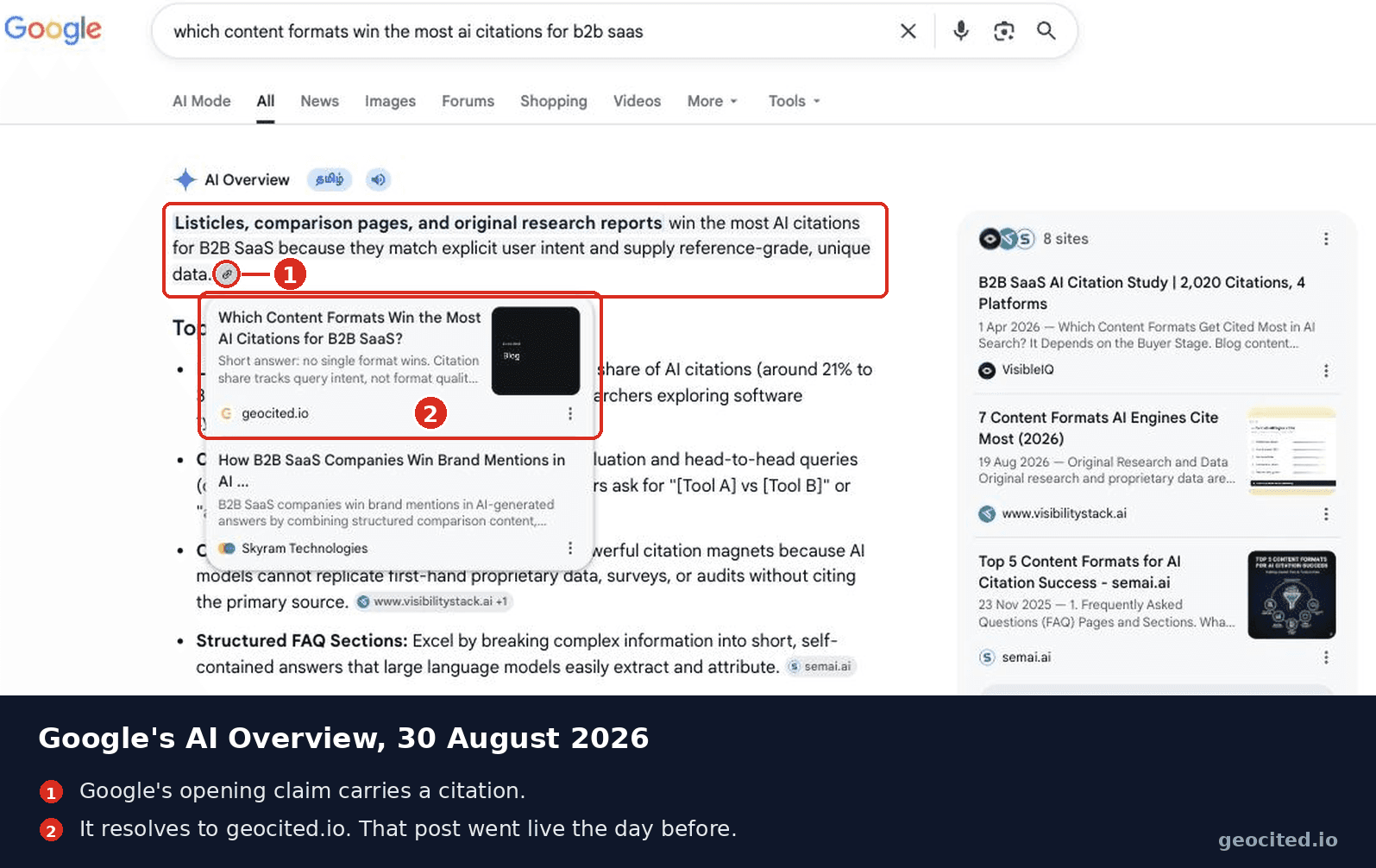
Listicles, comparison pages, and original research reports win the most AI citations for B2B SaaS because they match explicit user intent and supply reference-grade, unique data.
The citation attached to that opening line resolved to geocited.io. Two things had entered the answer that were not in the previous version: the phrase "because they match explicit user intent", which is our thesis, and a figure for comparison pages of "over 40% to 56% of citations" on head-to-head queries, where the previous version had carried no number at all. Our measured figure is 56.7%.
Observation 3, roughly four hours later
13 sourcesThirteen sources. The opening line had changed again:
For B2B SaaS, the content formats that win the most AI citations are those that directly match the buyer's query intent and provide extractable, structured data. No single format dominates all prompts; instead, citation share shifts depending on where the user is in the buying journey.
That is our finding, close to verbatim. Our article's answer block reads: "no single format wins. Citation share tracks query intent, not format quality."
But the citation pill on that opening line now reads VisibleIQ, not us. geocited.io remains in the 13-source pool without grounding any visible sentence.
What we can prove and what we can only observe
This distinction is the whole point of publishing a case study rather than a screenshot.
Proven, from Search Console
- The crawl time, the crawl result, and the indexed status.
- The link profile at the time of publication.
- That zero blog articles were indexed before this one.
- That the page is server-rendered, returns 200, loads all resources and throws no console errors.
Proven, from live search
- First position for the target query on 30 August 2026.
- geocited.io present in the AI Overview source pool at all three observations.
- geocited.io grounding the opening sentence at observation 2, captured in a screenshot with the hover state showing the domain.
- The exact wording of the AI Overview at each observation.
Observed but not proven
- That our article caused the AI Overview to change its thesis. The wording moved toward our finding across three regenerations while our page sat in the source pool. That is consistent with influence and it is not proof of it. We did not run a control.
- That the four content decisions below caused the ranking. We changed all of them at once, on one page, so we cannot separate their contributions.
Not true, and worth correcting because we have seen it repeated
- The AI Overview has not quoted "56.7%". It quoted a range topping at 56% at observation 2, and "over 50%" at observation 3. Our figure sits inside those ranges. It has not been reproduced exactly.
What we think did it
Four decisions, in the order we would rank them.
Original data.
The article contains numbers that exist in no other document: 56.7%, 78.8%, 20.6%, 0.6%. Every competing page on this query recycles the same third-party studies, and several recycle each other. When an answer engine needs a figure for head-to-head citation share, there was one place to get one.
This also carries a cost we did not anticipate. Uncorroborated numbers are the hardest for an answer engine to ground on, because grounding favours claims that repeat across the retrieved set. Being first is the same thing as being unconfirmed.
A direct answer written to be lifted.
The article opens with one bolded sentence that answers the title question completely, before any introduction. No throat-clearing, no context-setting. At observation 2 that was the sentence Google cited.
The title is the query.
Not a paraphrase, not a category term. The exact string a person types. The URL slug carries it too.
Published method, published data, published limitations.
We put the 40 prompts, the raw JSON, the classified CSV and a list of everything we could not verify on the page. We reported where our numbers conflict with Wix, Foundation Inc and Citera, and we explained why rather than picking a winner.
We cannot prove this fourth one contributed anything to ranking. We include it because it is the reason the article survives scrutiny, which matters more than the ranking.
What did not do it
Backlinks.
Seven referring domains per Ahrefs, one external link per Google Search Console, from x.com. No outreach, no digital PR, no link building of any kind.
Domain authority.
Nineteen indexed pages on a domain with under two months of indexed history.
Schema markup.
The page carries a full JSON-LD graph, and we do not credit it. Ahrefs published a matched difference-in-differences study on 11 May 2026 of 1,885 pages that added JSON-LD against 4,000 matched controls, and found Google AI Overviews at minus 4.6%, statistically significant, with no measurable effect on AI Mode or ChatGPT (vendor-funded, and the finding runs against Ahrefs' own commercial interest).
Google's own Search Central documentation, updated 10 December 2025, states it plainly: "There's also no special schema.org structured data that you need to add."
Age.
The page was hours old when it entered the source pool.
Volume.
One article. Not a content programme.
What is still broken
A case study that only reports wins is marketing. Here is what the same audit found.
Fifteen of the sixteen blog articles remain unindexed. This one got in because we pushed it manually through URL Inspection, which is capped at roughly ten to twelve submissions per day and does nothing for the rest.
The underlying causes are unresolved as of 30 August 2026:
A duplicate www host
www.geocited.io/services is indexed alongside the non-www version, so the www host is live and splitting signals.
Trailing-slash duplicates
/about/, /contact/, /blog/ and /audit/ are indexed as separate URLs from their non-slash equivalents. Seven URLs sit in "Page with redirect".
noindex where a 301 belongs
Four legacy policy URLs carry noindex instead of a 301, which keeps them in Google's known-URL set indefinitely.
A sitemap out of sync in both directions
It omits /glass-box, /citation-gap-report and /audit, which are live and indexed, and lists /sprint and /author, which are not.
Thin article metadata
og:type is missing on articles, and the Article schema emits bare dates rather than full ISO 8601 timestamps.
On a domain this new, duplicate hosts and duplicate paths consume most of the available crawl budget before Googlebot reaches an article. That is the real reason fifteen articles sat unindexed, and no amount of good content fixes it.
Where this shows up in ChatGPT
It does not, yet.
We ran the same query in a fresh ChatGPT temporary chat. Six sources returned, none of them ours. ChatGPT went to Wix and Citera, two of the primary studies our own article cites, reaching past our synthesis to our sources.
We then asked ChatGPT directly about the GeoCited 490-URL study. It surfaced geocited.io/citation-gap-report and geocited.io/services and could not produce the article. The domain is in ChatGPT's search index. The article is not.
This is crawl lag, not a content problem, and there is no Request Indexing equivalent for OpenAI. The discovery path is internal links from the pages already in that index.
What we would tell a client to copy
Fix crawl before you fix content. One canonical host, one trailing-slash convention, 301 the legacy URLs, generate the sitemap from the route manifest. Nothing downstream works reliably until this is done.
Answer the question in the first sentence. Before the introduction, before the context. That sentence is the unit an answer engine lifts.
Make the title the query, verbatim. Including in the slug.
Publish something nobody else has. A test you ran, numbers you collected, a dataset you built. If your page only restates other people's studies, an answer engine has no reason to prefer you over the studies themselves.
Publish the method and the limitations. It costs you nothing in ranking and it is the only thing that survives someone checking your work.
Push the first article manually, then stop relying on that. URL Inspection is a patch. Internal links and crawl hygiene are the fix.
Limits of this case study
Stated plainly, because everything above is worth exactly as much as these caveats allow.
One page, one query, one domain.
A sample of one is an anecdote with timestamps.
No control.
Four variables changed at once. We cannot attribute the outcome to any one of them.
Two days old.
Rankings on a fresh page move. SISTRIX measured 74% weekly drift in cited domains on ChatGPT and 5% on Google AI Overviews across 82,619 prompts and 1,548,213 snapshots between 17 December 2025 and 8 April 2026 (vendor-funded). Our own morning showed the AI Overview regenerating three times in a few hours, which is faster than that 5% average implies for a page this new.
The target query is long-tail.
Low competition. Position one on day one is normal there and says little about head terms, where we do not rank.
Single geography.
All checks from one Indian IP on one logged-in profile.
Our inline citation has already come and gone.
We grounded the opening sentence at observation 2 and did not at observation 3. Anyone presenting one screenshot as a stable state, including us, is overstating it.
Frequently asked questions.
In this case yes. On 29 and 30 August 2026 a page on a domain with 7 referring domains per Ahrefs and 1 external link per Google Search Console entered the AI Overview source pool for its target query and, at one observation, grounded the opening sentence of the answer. That is one page on one query, not a general rule.
Sources and raw data
- Does Schema Markup Predict AI Citations? — Ahrefs, 11 May 2026 (vendor-funded)
- AI Features and Your Website — Google Search Central, updated 10 December 2025
- AI Citation Drift — SISTRIX, 1 May 2026 (vendor-funded)
- The article this case study is about — GeoCited, 29 August 2026
Want the same test run on your site?
We ran this one on ourselves first. The method is the same one clients get — real buyer prompts, run live against the engines, every answer archived, every number dated, and every limit written down next to it.