How ChatGPT Searches Now: The Pipeline Behind Every Cited Answer (September 2026)
ChatGPT searches the web on a minority of prompts. When it does, it rewrites your question into several narrower queries, increasingly aimed at named websites, pulls results from OpenAI's own index and from scraped Google results, reads a short snippet or a cached copy of each page, and cites roughly half of what it retrieves. Nothing in that pipeline is a ranking you can hold.

How ChatGPT search works in September 2026: when it searches, how it rewrites your question, where results come from, and what it reads and cites.
On this page
Note on verification: every claim below carries a live link and a date, and was fetched from its publisher on 16 September 2026. OpenAI has never published how ChatGPT selects or orders sources, so most of what follows comes from outside researchers watching the product from the browser, and several of them sell AI visibility software; those are labelled vendor-funded where they are cited. Four things could not be verified and are flagged inline: the cause of the August 2026 Reddit citation drop (OpenAI has not commented), the year of the OpenAI antitrust testimony quoted by Peec AI, how much of ChatGPT's retrieval still runs through Microsoft, and whether the internal query syntax described here is still current. The only outside measurement of GPT-6 Astra so far is one vendor's 50-prompt test on a single account, so the Astra figures are directional. Most of this research relied on a data field that OpenAI removed on 21 July 2026, and the system has changed at least twice since. Treat this as a dated snapshot, not a specification.
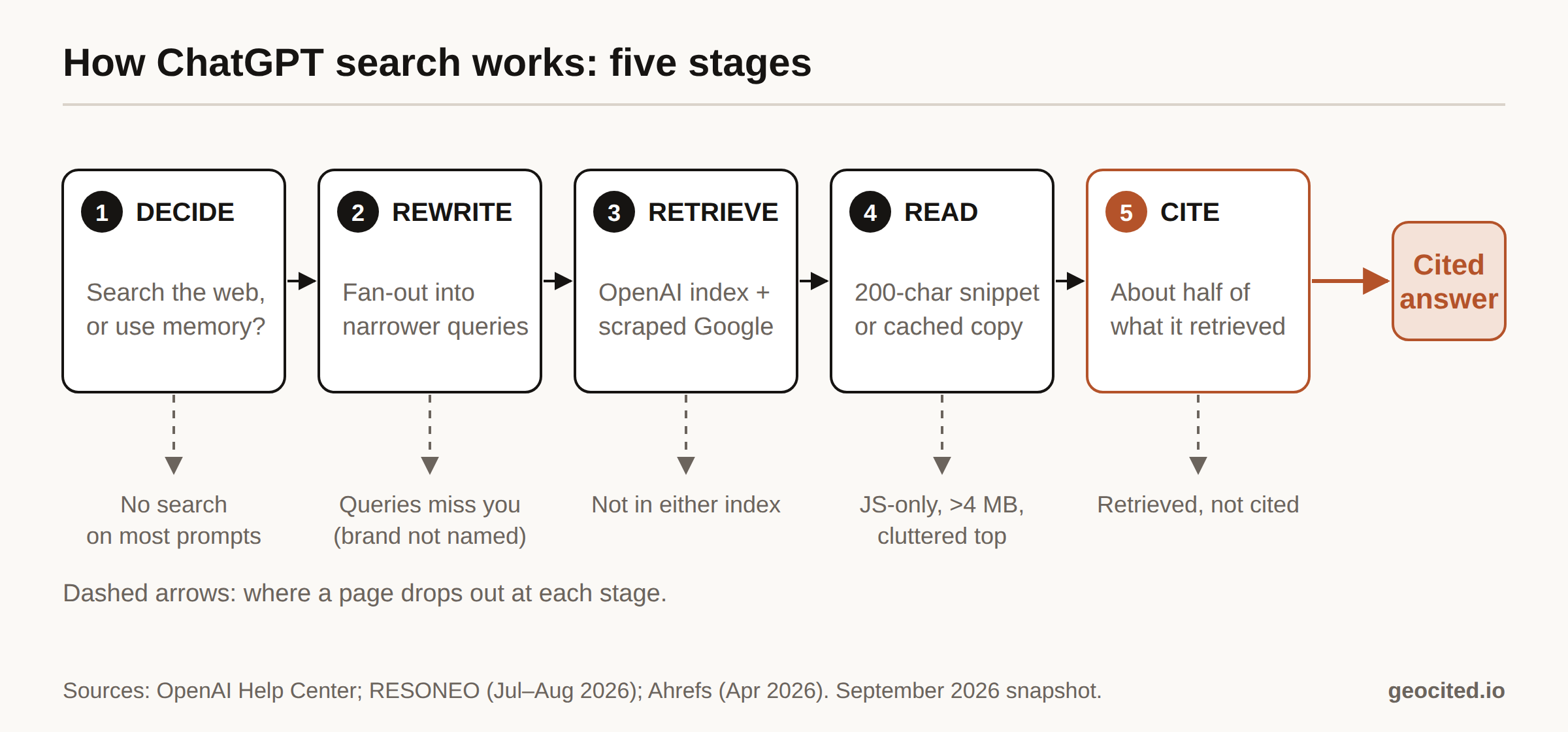
Most explanations of ChatGPT search still describe the October 2024 launch version: a chatbot that sends your question to Bing and summarises the top results. Almost none of that is accurate any more. Over the past nine months, outside researchers have taken the pipeline apart from the browser side, and the picture they found has five distinct stages. Each one decides something different about whether your page shows up.
Stage 1: Deciding whether to search at all
Before anything else, the model decides whether your question needs the live web. OpenAI's own wording is that ChatGPT "may search the web automatically when your question would benefit from current information" (OpenAI Help Center, "Searching the web with ChatGPT").
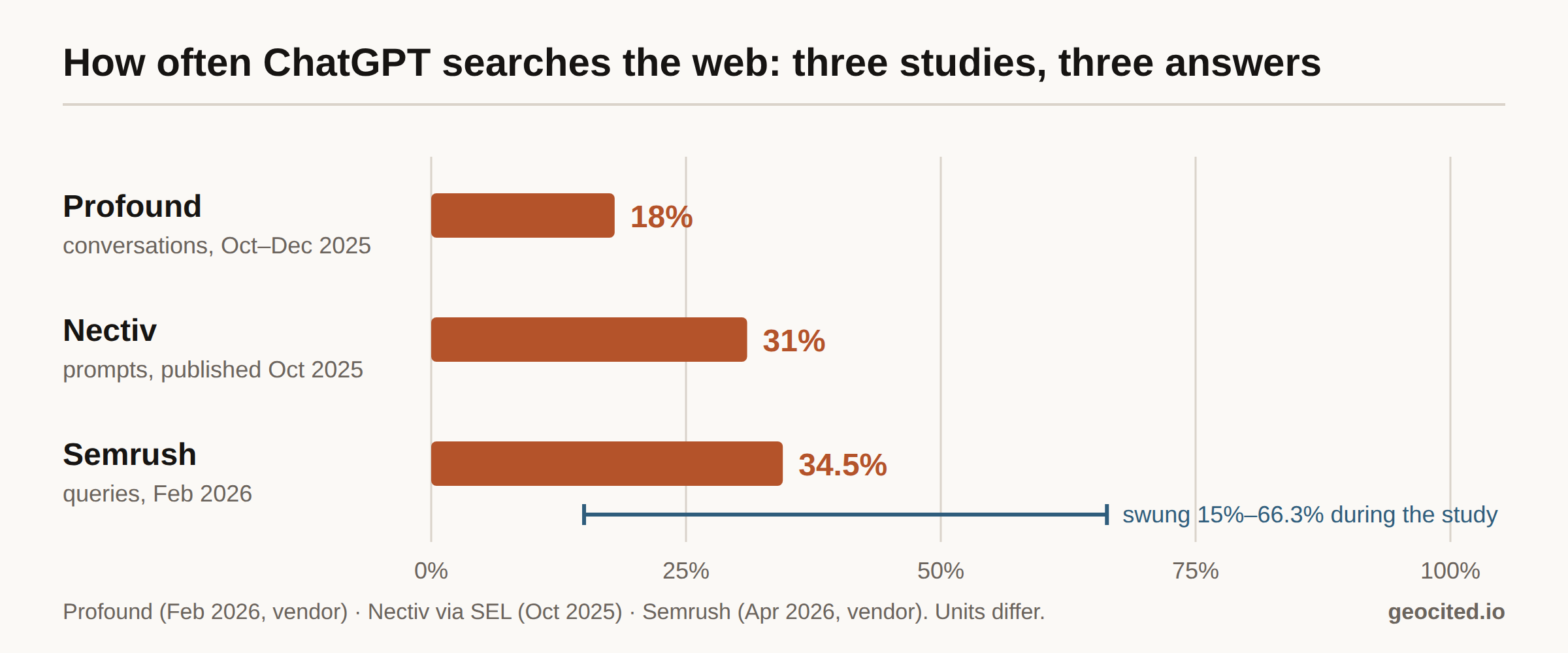
How often that happens depends on who measured it, and the three best-known figures do not agree:
| Study | Method | Share that triggered a search |
|---|---|---|
| Profound, Feb 3, 2026 (vendor-funded) | ~730,000 US English conversations, Oct to Dec 2025 | about 18% of conversations |
| Nectiv, via Search Engine Land, Oct 15, 2025 | 8,500+ prompts across nine industries | 31% of prompts |
| Semrush, Apr 7, 2026 (vendor-funded) | US clickstream panel, Oct 2024 to Feb 2026 | 34.5% of queries, down from 46% in late 2024 |
Sources: Profound, Search Engine Land, Semrush.
These measure different units (conversations, prompts, sessions) over different windows, so they conflict rather than average out. Semrush's own data shows the rate swinging between 15% and 66.3% during its study period, which is the more useful finding: the trigger rate is a product setting that OpenAI moves, not a stable property of user behaviour.
Two things push it around. Intent matters: Nectiv found local queries triggered a search 59% of the time, against 18% for credit card queries. And OpenAI has been adding ways to skip search entirely. Its release notes for 22 April 2026 describe "fast answers" for common information questions when the model has a "high-confidence answer ready" (OpenAI release notes). A question the model thinks it already knows the answer to never reaches the web, which means your page never gets a chance.
The practical point for a B2B company: category and comparison questions sit in the searched bucket, and "what is X" questions often do not. That is why training-data presence and live retrieval are two separate problems.
Stage 2: Rewriting your question into several searches
ChatGPT does not search for what you typed. OpenAI says it "typically rewrites your query into one or more targeted queries that it sends those providers," and that if memory is on, it "may use relevant saved memories when rewriting a search query." It may also use "an approximate location based on your IP address" (OpenAI Help Center). So two people typing the same words can send different searches.
The rewriting step is called query fan-out, and how wide it goes depends on the mode. Olivier de Segonzac, co-founder of the French SEO consultancy RESONEO, reported that ChatGPT's thinking model chains five to ten or more search rounds per response, while the instant model typically runs two or three (Search Engine Land, May 14, 2026). The internal browsing tool, called web.run, now supports operations including search_query, open, find, click, screenshot and product_query, plus widgets for sports, finance and weather.
The August 2026 change: searches aimed at named sites
The biggest recent shift is where those rewritten queries point. Suganthan Mohanadasan inspected ChatGPT's browser traffic on a single Plus account across eight queries between 16 and 20 August 2026 and found a compact query format that looks like this (Suganthan Mohanadasan, Aug 21, 2026):
fast|Zendesk AI agents pricing 2026|30|zendesk.com
Reading it left to right: a call type, the query string (with brand names the model has already chosen), a freshness window in days, and an optional domain slot that works like a site: operator. He observed freshness windows of 2 days for stocks, 7 for sports, 30 for commercial queries and 90 to 365 for others. Other call types included product, business (for places, with a location), image and genui_run (for widgets).
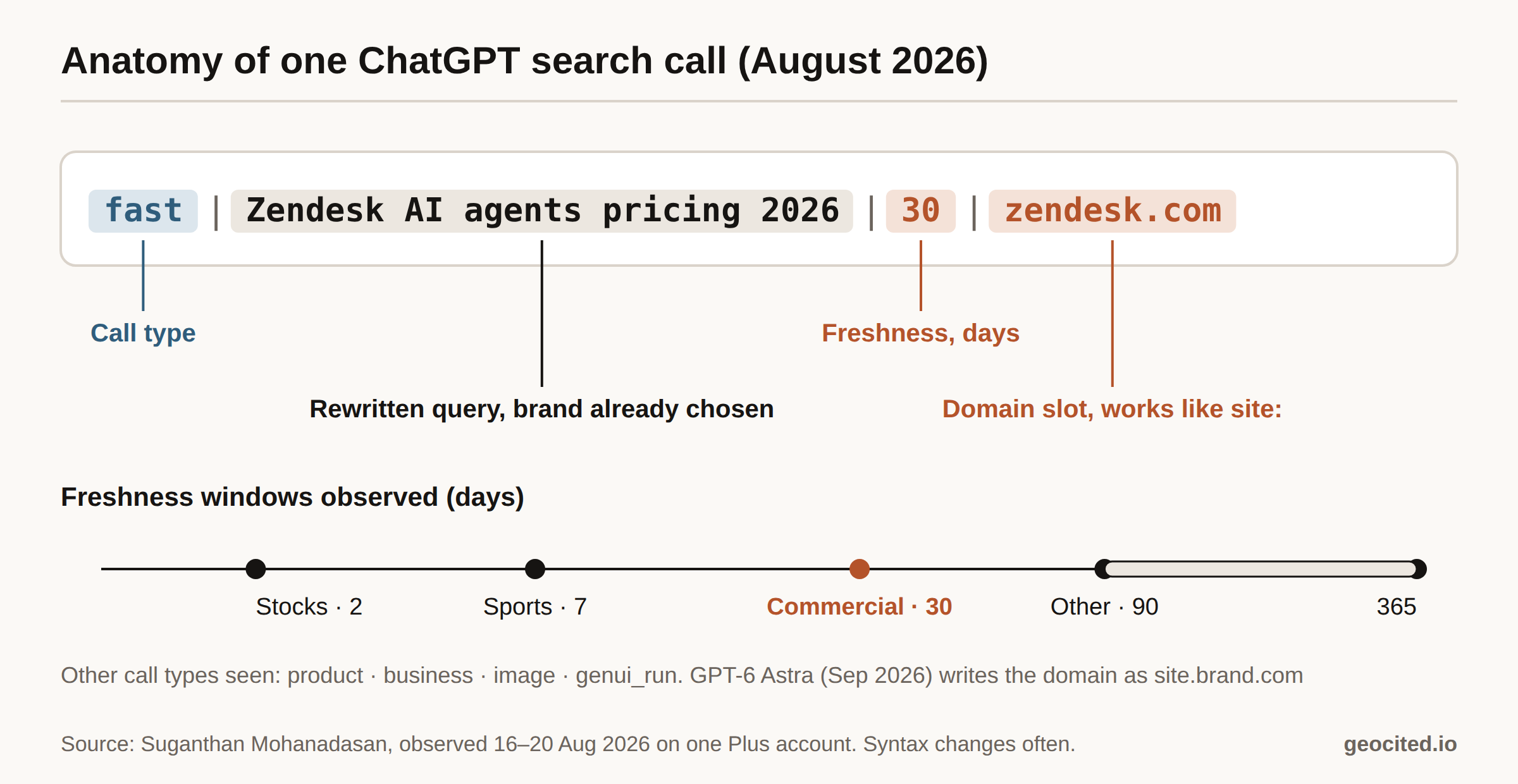
This syntax has flipped at least twice this year. De Segonzac reported in May that ChatGPT moved from pipe-separated commands to structured JSON with a model update in March. Mohanadasan reported in August that it had moved from JSON back to a pipe format, now with the domain slot. Both were observed from the browser on specific accounts and may already have changed again, which we could not verify.
The domain slot matters because of what it did to the numbers. Promptwatch, which sells AI visibility tracking, reported that domain-scoped searches rose from about 0.37% of fan-out queries to 16.8% on 8 August 2026, and that average searches per response rose from about 1.08 to 1.83 (Promptwatch, Aug 20, 2026, updated Sep 8, 2026, vendor-funded). When the model searches a vendor's own domain for "pricing" or "integrations", the vendor's own pages win that retrieval by default.
The step before the search
One claim here deserves care. De Segonzac argues that ChatGPT forms its queries around sources and brands it already knows from training, and that "a brand absent from parametric memory won't even be considered as a search candidate" (Search Engine Land, May 14, 2026). The Zendesk example above is consistent with that: the brand name is already in the query. It is a reasonable reading of the observed queries, not something OpenAI has confirmed, and a generic query like "best help desk software" can still surface a brand the model did not name. But if your company is not already known to the model, you are relying on generic queries to find you.
Stage 3: Where the results actually come from
The "ChatGPT runs on Bing" claim is the most repeated and least current statement in this category.
OpenAI's help page says only that ChatGPT uses "third-party search providers" and links to Microsoft's and Shopify's privacy policies (OpenAI Help Center), so Microsoft is at least one provider. Beyond that, the best evidence comes from a two-month window when ChatGPT exposed a result_source field in its data stream.
RESONEO captured 1,249 real conversations during that window, yielding 88,000 search results from 26,900 distinct pages, and identified the engines behind them (RESONEO, Jul 2026, updated Aug 2026):
- labrador, OpenAI's own index
- bright, scraped Google results
- oxylabs, which RESONEO links to news feeds
- a minor SERP channel
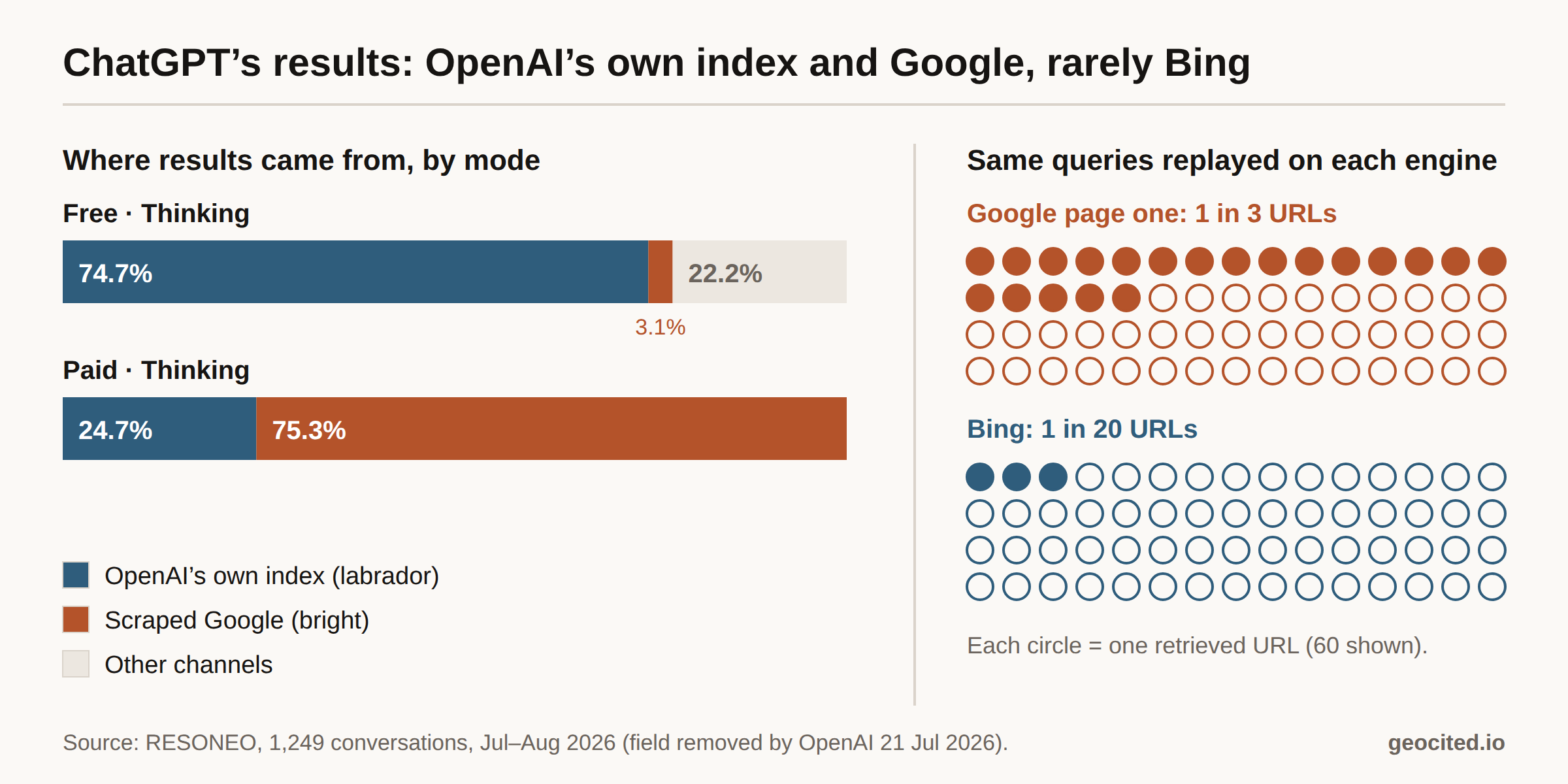
When RESONEO replayed ChatGPT's own queries against both engines, "one URL in three shows up on Google's first page. Only one in twenty on Bing." That is the strongest evidence we found that the external results ChatGPT leans on now come from Google rather than Microsoft. It is also consistent with an August 2025 report by The Information, summarised by Search Engine Land, that OpenAI had used SerpApi to pull Google results (Search Engine Land, Aug 26, 2025). No party commented on that report.
Which engine you hit depends on your plan and mode. RESONEO's figures, as reported by Search Engine Land (Aug 17, 2026):
| Free, instant | Free, thinking | Paid, thinking | |
|---|---|---|---|
| URLs per conversation | 15.1 | 35.3 | 33.9 |
| Distinct domains | 9.8 | 16.3 | 15.5 |
| Results from OpenAI's index | not reported | 74.7% | 24.7% |
| Results from scraped Google | not reported | 3.1% | 75.3% |
Read plainly: free users mostly get OpenAI's own index, and paying users in thinking mode mostly get Google's results. A page that ranks on Google but is missing from OpenAI's index will show up for one group and not the other.
OpenAI is working to shift that balance. Tomek Rudzki of Peec AI, another AI visibility vendor, reports that labrador is "not one index but a family of vertical ones," that an experiment named prefer-index-over-serp-v3 was affecting 8% of chats in mid-August 2026, and that ChatGPT draws on at least eight external providers including Google results, Yelp and TripAdvisor (Peec AI, Sep 4, 2026, vendor-funded). He also cites testimony by Nick Turley, head of ChatGPT, in Google's antitrust case, that OpenAI began building its own index in 2023 after Google declined to work with it. Peec dates that testimony to 2024; we could not confirm the date independently. Peec's article also describes a Microsoft grounding platform as powering ChatGPT, which we could not verify either.
The field that made all of this visible is gone. RESONEO reports that OpenAI removed result_source from the stream on 21 July 2026 and encrypted its shopping data at the same time. Nobody outside OpenAI can currently repeat this measurement the same way.
The vertical lanes
Not every result comes through general web search. Ahrefs' analysis of 1.4 million desktop prompts found five retrieval channels: search, news, Reddit, YouTube and academia, with the general search channel accounting for 88.46% of citations (Ahrefs, Apr 15, 2026, vendor-funded). On top of that, OpenAI has added vertical features through 2026: shopping comparisons with "price, reviews, and features" (24 March), live job listings from sources including Indeed and Upwork (1 June), and restaurant bookings through OpenTable, Resy and Yelp (10 August), all listed in the ChatGPT release notes. For those queries, a structured feed or listing counts for more than a web page does.
Stage 4: What the model actually reads
Most people assume ChatGPT reads your page. Most of the time, it does not.
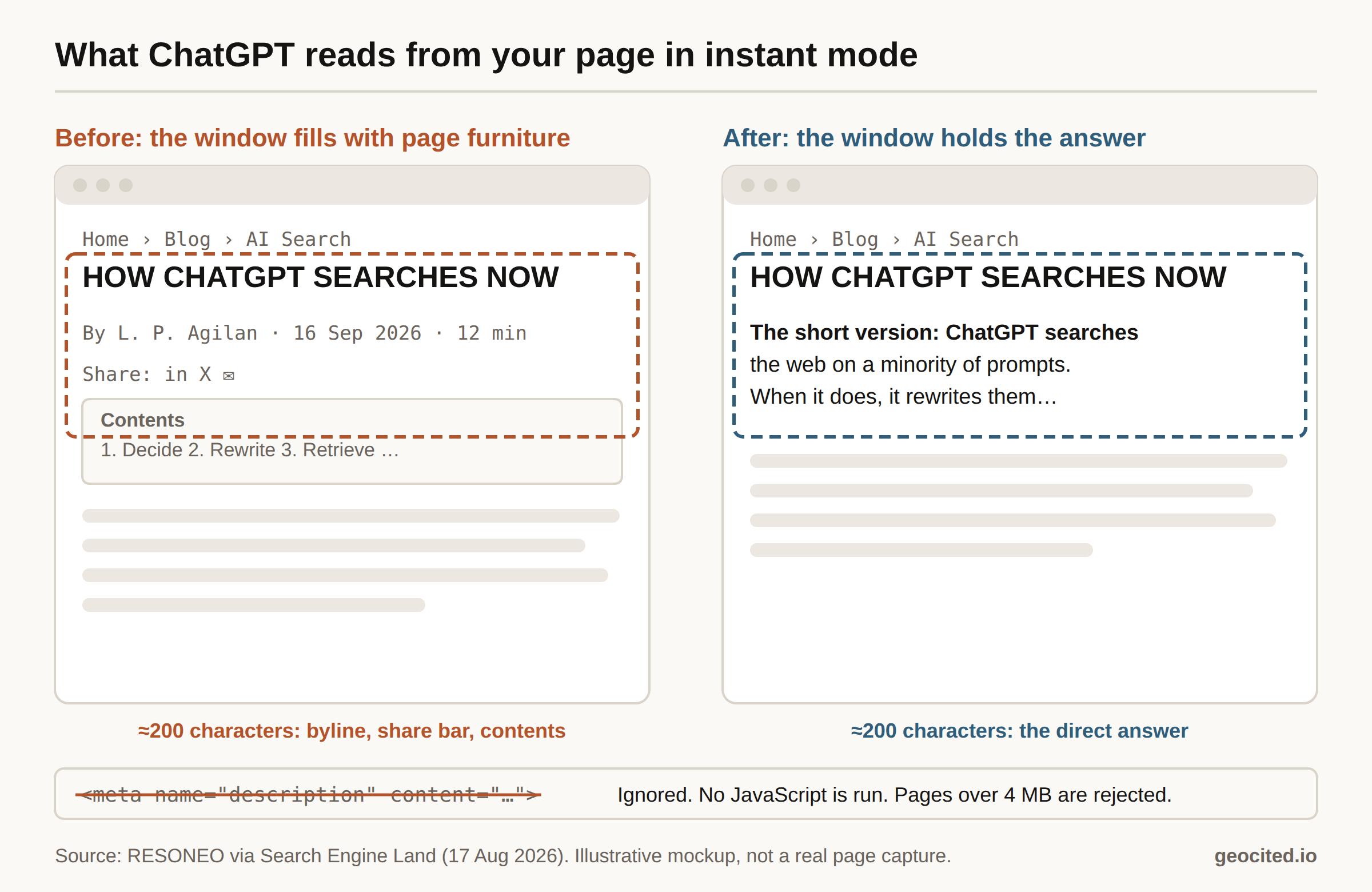
In instant mode, it usually reads a snippet. RESONEO found that the search results passed to the model carry a title, a URL and a snippet of about 200 characters that "is taken from the start of the page's rendered body, not from your metadata" (RESONEO). Search Engine Land's write-up adds that the snippet is anchored on your H1 "plus whatever visible text sits immediately around it," which can include category labels, bylines, dates and a table of contents, and that the meta description is ignored for these results (Search Engine Land, Aug 17, 2026). Only 759 pages were opened live across RESONEO's entire corpus.
When it does read a page, it often reads a cached copy. The same study describes a reading cache, shared across all users and plans, that stores pages converted from HTML to Markdown. A copy is treated as fresh for about 30 minutes, and "the copy created by one account is served back to another account... without a single hit reaching the origin server." Search Engine Land reports that the cache ignores Cache-Control: no-store and noindex. Note the tension with OpenAI's own publisher FAQ, which tells site owners to use the noindex meta tag if they do not want a page surfaced (OpenAI Help Center, Publishers and Developers FAQ). The two statements may describe different layers (being shown versus being stored), but we could not confirm that.
Two hard technical limits, both from RESONEO: the fetcher does not execute JavaScript, so content rendered client-side is invisible, and pages over 4 MB are rejected with an HTTP 400 rather than truncated.
Different bots do different jobs. OpenAI documents four (OpenAI crawler docs):
| Bot | What it does | Does robots.txt apply? |
|---|---|---|
| OAI-SearchBot | Surfaces sites in ChatGPT search results | Yes. Blocked sites are not shown in search answers, though they may still appear as navigational links |
| ChatGPT-User | Fetches pages for user-initiated actions | "May not apply," per OpenAI |
| GPTBot | Collects data that may be used for model training | Yes. Blocking it opts out of training, not search |
| OAI-AdsBot | Checks the safety of pages submitted as ads | Only visits submitted ad pages |
OpenAI says robots.txt changes take about 24 hours to take effect, and publishes IP ranges for each bot. De Segonzac notes that ChatGPT-User, not OAI-SearchBot, is the agent that fetches page content once results have been chosen (Search Engine Land, May 14, 2026). Blocking GPTBot to keep out of training does nothing to your search visibility. Blocking OAI-SearchBot, or letting a firewall block its IP ranges, does.
Stage 5: Choosing what to cite
Retrieval gets you into the pool. Citation is a second, stricter filter.
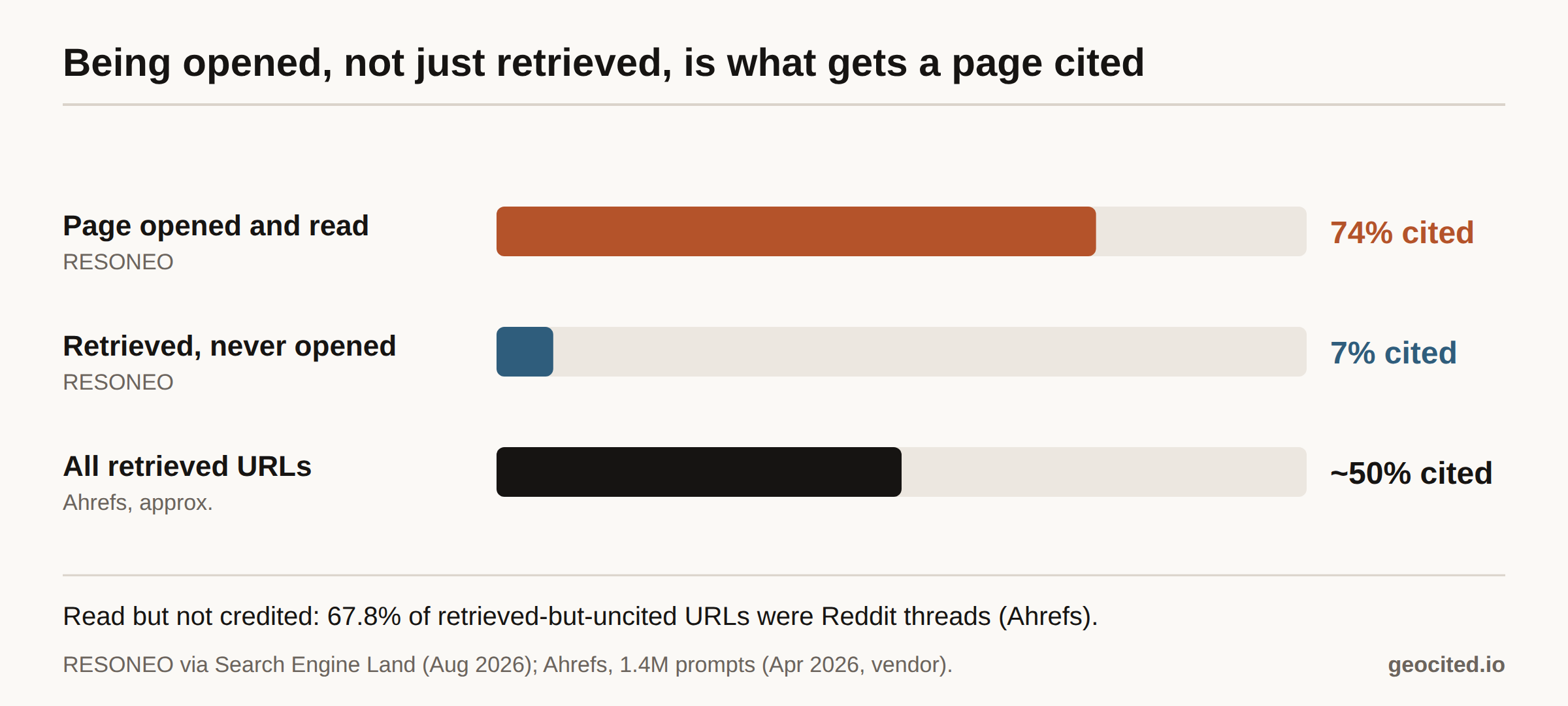
About half of what is retrieved gets cited. Ahrefs found ChatGPT cites roughly 50% of the URLs it retrieves (Ahrefs, Apr 15, 2026).
Opened pages win. RESONEO found pages ChatGPT opened were cited 74% of the time, against 7% for pages that were only retrieved (Search Engine Land, Aug 17, 2026).
Titles that match the rewritten query win. Ahrefs measured semantic similarity between titles and queries: 0.656 between fan-out queries and cited titles, against 0.484 between prompts and non-cited titles. Pages with natural-language URL slugs had an 89.78% citation rate against 81.11% for those without. The median cited page was around 500 days old, so freshness is not the filter people assume, except for news, where newer pages did better. (Ahrefs dates its prompt sample to February 2025 while naming a 2026 model version, so we have left the sample date out.)
Some sources are read and not credited. In Ahrefs' data, 67.8% of URLs that were retrieved but not cited came from Reddit. Mohanadasan saw the same thing live: in one capture, 84 of 221 entries in the retrieval pool were Reddit threads and none were cited (Suganthan Mohanadasan, Aug 21, 2026). Reddit appears to shape what ChatGPT believes about a product without appearing in the answer.
Some citations do not come from the search at all. RESONEO found that in instant mode, URLs without a snippet were cited more often than URLs with one (14.9% against 8.2%), and suggests some citations come from the model's memory rather than from retrieval. That is an open puzzle, not a finding to build on.
What changed in August and September 2026, and what is still unexplained
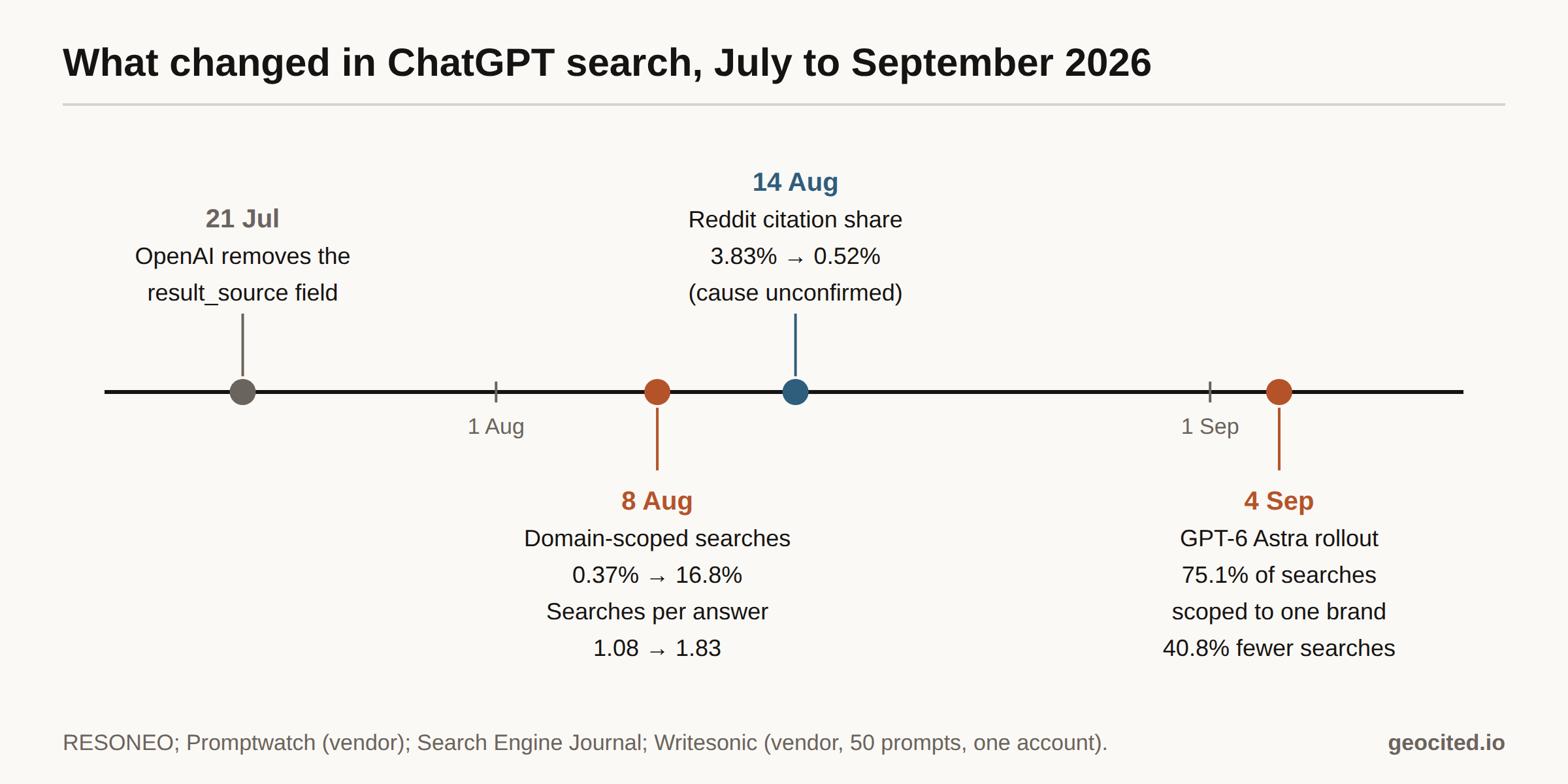
Reddit's share of ChatGPT citations fell from an average of 3.83% (18 July to 7 August) to 0.52% (14 to 17 August), an 86.4% relative drop, according to Promptwatch (Promptwatch, Aug 20, 2026, vendor-funded). The popular explanation is the domain-scoped searches that started on 8 August: nobody runs a site:reddit.com search for a vendor's pricing page, so official sites and documentation took the slots.
That explanation does not fully fit the dates. Search Engine Journal pointed out that Promptwatch's own data shows two drops, one on 8 August and a sharper one on 14 August, six days later. It also noted that a similar Reddit drop in September 2025 was attributed by Kevin Indig to Google removing the num=100 search parameter, which cut off deeper results where Reddit threads sit. OpenAI did not respond to a request for comment (Search Engine Journal, Aug 19, 2026). The cause is unconfirmed.
4 September: GPT-6 Astra
OpenAI began rolling out GPT-6 Astra on 4 September 2026 to Plus, Pro, Business and Enterprise users, with Enterprise access off by default at launch (9to5Mac, Sep 4, 2026). OpenAI's announcement says the model can "conduct online research" but gives no detail on how it searches or cites (OpenAI, "GPT-6 Astra").
The first outside measurement comes from Writesonic, which sells AI visibility software. It ran 50 prompts once each on a single US Plus account on 7 and 8 September, comparing Astra with GPT-5.6 Sol (Writesonic, Sep 8, 2026, vendor-funded). Its findings:
- Astra ran 6.1 searches per answer against 10.3 for Sol, 40.8% fewer.
- 75.1% of Astra's searches were scoped to a single brand's domain. Counting pages it opened directly by URL, 83% of its search budget went to brand-owned pages.
- 71.1% of its citations went to first-party sites, which Writesonic describes as "about as often as the model before it."
- Answers were roughly 12% shorter.
One detail matters for anyone measuring this. Astra writes the operator as site.brand.com, with a period, rather than site:, and Writesonic says it had to patch its own detection to catch it. A tracker or regex that looks only for site: will undercount Astra's domain-scoped searches. Writesonic calls its results directional, and on Plus accounts Astra was only available in ChatGPT's "Work" surface, so this is not yet what a typical free user sees.
What is clear is the direction across August and September: fewer searches, and more of them aimed at the vendor's own domain. If your pricing, integration and documentation pages are thin or blocked, a domain-scoped search on your site comes back with nothing useful to quote.
Why the same question gives different sources
Every stage above has moving parts, so the output moves too.
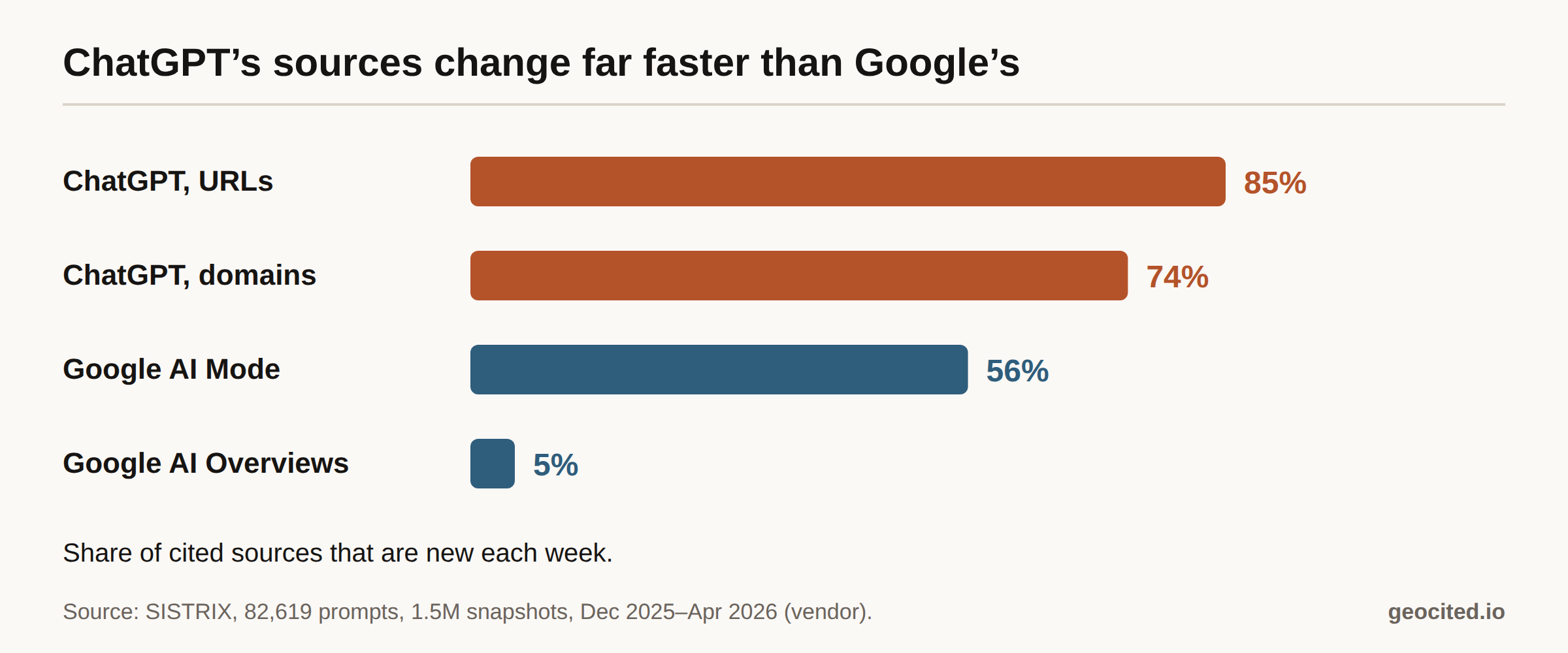
SISTRIX, an SEO software vendor, tracked 82,619 prompts across 1,548,213 snapshots and found that 74% of the domains ChatGPT cites are new each week, rising to 85% at URL level. Google AI Mode churned 56% weekly and Google AI Overviews only 5% (SISTRIX, May 1, 2026, vendor-funded). The steadier end of that range works differently, and we cover how Google AI Overviews choose sources on its own terms.
Model changes cause step changes on top of that. SISTRIX reported that a model switch on 22 to 23 May 2026 shifted the domain mix in German-language ChatGPT answers by 47% within 48 hours, against a typical daily variation of 1 to 2%, across 3.8 million responses (SISTRIX, Jun 1, 2026, vendor-funded). De Segonzac separately reported that after a model switch on 4 March 2026, the average number of unique domains cited per response fell from 19 to 15 (Search Engine Land, May 14, 2026). The two sources describe the model versions involved differently, so we have reported the dates rather than the model names.
This is the structural reason there is no "ranking" in ChatGPT. A position has to hold still long enough to be measured. What can be measured is how often you appear across a defined set of buyer questions, run repeatedly. We cover that in How to Rank in ChatGPT (The Honest Answer).
The part you cannot buy
OpenAI now shows ads to Free and Go users in several markets. In its announcement it states that "Ads do not influence the answers ChatGPT gives you" and that ads are "clearly labeled as sponsored and visually separated from the organic answer." Pro, Business, Enterprise and Education plans do not show ads (OpenAI, Feb 9, 2026, updated Aug 11, 2026). You can buy a placement next to the answer. Nobody can sell you a place inside it.
What this means for a B2B software site
Put the five stages together and the list of useful actions is short.
- Let the right bots in. Allow OAI-SearchBot in robots.txt and make sure your CDN or firewall is not blocking its published IP ranges. Decide on GPTBot separately. See our technical checklist.
- Serve your content as HTML. If the text only appears after JavaScript runs, ChatGPT's fetcher does not see it. Keep pages under 4 MB.
- Clean up the first 200 characters. Put a clear H1 and a direct answer right after it. Move breadcrumbs, share widgets and tables of contents out of the way, because in instant mode that short stretch is often all the model reads.
- Build the pages domain-scoped searches look for. Pricing, integrations, security, documentation and comparison pages on your own domain, with titles that match the plain questions buyers ask.
- Rank on Google too. Paid thinking mode drew three quarters of its results from Google in RESONEO's data. Good SEO is still most of the retrieval work, which is why we describe the tactics as heavily overlapping with SEO. The parts that are different are measurement, prompt research and coverage across several engines.
- Get talked about elsewhere. If the model has never heard of you, it may never write your name into a query. Third-party mentions are how you get into its memory.
- Measure repeatedly, not once. With 74% weekly domain churn, a single screenshot proves nothing.
One measurement gap to plan around: OpenAI adds utm_source=chatgpt.com to referral links (OpenAI Publishers FAQ), so clicks show up in analytics. Reads do not. As Search Engine Land puts it, the pages the model read in full "leave zero UTM trace," and cached reads never reach your server at all.
Sources
- Searching the web with ChatGPT, accessed 16 Sep 2026 — OpenAI Help Center — https://help.openai.com/en/articles/9237897-chatgpt-search
- Publishers and Developers FAQ, accessed 16 Sep 2026 — OpenAI Help Center — https://help.openai.com/en/articles/12627856-publishers-and-developers-faq
- Overview of OpenAI crawlers, accessed 16 Sep 2026 — OpenAI — https://developers.openai.com/api/docs/bots
- ChatGPT release notes, accessed 16 Sep 2026 — OpenAI Help Center — https://help.openai.com/en/articles/6825453-chatgpt-release-notes
- GPT-6 Astra, accessed 16 Sep 2026 — OpenAI — https://openai.com/index/gpt-6-astra/
- OpenAI releasing major upgrade to ChatGPT and Codex with GPT-6 Astra, Sep 4, 2026 — 9to5Mac — https://9to5mac.com/2026/09/04/openai-releasing-major-upgrade-to-chatgpt-and-codex-with-gpt-6-astra-details-here/
- GPT-6 Astra citation study, Sep 8, 2026 (vendor-funded) — Writesonic — https://writesonic.com/blog/gpt-6-astra-citation-study
- Testing ads in ChatGPT, Feb 9, 2026, updated Aug 11, 2026 — OpenAI — https://openai.com/index/testing-ads-in-chatgpt/
- How ChatGPT sources the web, Feb 3, 2026 (vendor-funded) — Profound — https://www.tryprofound.com/blog/chatgpt-citation-sources
- ChatGPT performs a search in 31% of prompts, Oct 15, 2025 — Search Engine Land — https://searchengineland.com/chatgpt-search-prompts-data-463407
- ChatGPT traffic analysis, Apr 7, 2026 (vendor-funded) — Semrush — https://www.semrush.com/blog/chatgpt-search-insights/
- Inside ChatGPT Search: how web.run and fan-out queries shape AI visibility, May 14, 2026 — Search Engine Land (Olivier de Segonzac) — https://searchengineland.com/inside-chatgpt-search-web-run-fan-out-queries-ai-visibility-477339
- Inside ChatGPT's retrieval stack, Aug 17, 2026 — Search Engine Land (Olivier de Segonzac) — https://searchengineland.com/chatgpt-retrieval-stack-index-cache-pages-485036
- ChatGPT retrieval study, Jul 2026, updated Aug 2026 — RESONEO — https://think.resoneo.com/chatgpt-retrieval/
- ChatGPT Rebuilt Its Search Tool. I Read the New Language It Speaks., Aug 21, 2026 — Suganthan Mohanadasan — https://suganthan.com/blog/chatgpt-new-search-language/
- Why Did ChatGPT Stop Citing Reddit?, Aug 20, 2026, updated Sep 8, 2026 (vendor-funded) — Promptwatch — https://promptwatch.com/blog/chatgpt-stop-citing-reddit
- Why Reddit's ChatGPT Citation Drop Isn't Fully Explained, Aug 19, 2026 — Search Engine Journal — https://www.searchenginejournal.com/why-reddits-chatgpt-citation-drop-isnt-fully-explained/586479/
- ChatGPT built its own search index, Sep 4, 2026 (vendor-funded) — Peec AI — https://peec.ai/blog/chatgpt-built-its-own-search-index
- ChatGPT's answers came from Google Search after all: Report, Aug 26, 2025 — Search Engine Land — https://searchengineland.com/openai-chatgpt-serpapi-google-search-results-461226
- Why ChatGPT cites pages, Apr 15, 2026 (vendor-funded) — Ahrefs — https://ahrefs.com/blog/why-chatgpt-cites-pages/
- AI Citation Drift, May 1, 2026 (vendor-funded) — SISTRIX — https://www.sistrix.com/blog/ai-citation-drift-how-stable-are-sources-in-ai-search-results/
- ChatGPT Core Updates, Jun 1, 2026 (vendor-funded) — SISTRIX — https://www.sistrix.com/blog/chatgpt-core-update/
Frequently asked
Does ChatGPT search use Bing or Google?
Both have been involved, and the balance has shifted towards Google and OpenAI's own index. RESONEO found that one in three URLs ChatGPT retrieved appeared on Google's first page and only one in twenty on Bing's. OpenAI says only that it uses third-party search providers, and it links to Microsoft's privacy policy.
How often does ChatGPT search the web?
Estimates range from about 18% of conversations (Profound) to 31% of prompts (Nectiv) and 34.5% of queries (Semrush). The studies measure different things, and Semrush saw the rate swing between 15% and 66.3%, so no single figure is settled.
What is query fan-out in ChatGPT?
Query fan-out is ChatGPT rewriting one question into several narrower searches before retrieving results. The instant model typically runs two or three search rounds and the thinking model five to ten or more. Since August 2026 many of these searches target a specific website's domain.
Does ChatGPT read my whole page?
Usually not. In instant mode ChatGPT usually sees a title, URL and a roughly 200-character snippet taken from the start of the page body. Full pages are read mainly in thinking mode, often from a shared cache rather than your server, and JavaScript is not executed.
Does blocking GPTBot remove my site from ChatGPT search?
No. GPTBot collects training data. OAI-SearchBot controls whether your site appears in ChatGPT search answers. Blocking GPTBot opts you out of training only; blocking OAI-SearchBot removes you from search answers.
Why did Reddit disappear from ChatGPT citations?
Reddit's citation share fell about 86% in mid-August 2026, according to Promptwatch. A shift to domain-scoped searches on 8 August is the common explanation, but the sharper drop came six days later and OpenAI has not commented, so the cause is unconfirmed. ChatGPT still reads Reddit threads heavily without citing them.
Does GPT-6 Astra search differently from earlier ChatGPT models?
Early evidence says yes. In Writesonic's 50-prompt test, Astra ran about 40% fewer searches than GPT-5.6 Sol, and three in four of its searches were scoped to a single brand's website. That is one vendor's single-account test, so treat it as directional.
Can I pay to appear in ChatGPT answers?
No. OpenAI states that ads do not influence ChatGPT's answers and are shown separately, labelled as sponsored. Any vendor promising a guaranteed position inside the answer is promising something the system does not offer.
Written by

Lourdes Paul Agilan runs GeoCited, a generative engine optimization agency. He works with B2B companies on how AI assistants describe and recommend them. He writes about that work here, and shares the experiments behind it. The tests that worked, and the tests that did not, written up the same way.