How to Appear in Google AI Overview: What Got a 7-Backlink Site In, and Why It Fell Out
To appear in a Google AI Overview, your page must be indexed and eligible to show a snippet. Google says nothing else is required. Beyond that, what helps is ranking for the narrower questions Google searches behind the scenes, answering in your first sentence, and publishing data nobody else has. Our new page got in within a day. Seventeen days later, it had dropped out.

How to appear in Google AI Overview: the four eligibility checks, what raises your odds, and our test of a new page that got in within a day.
On this page
Note on verification: Google's requirements below come from its own Search Central documentation. The external studies were fetched from their publishers on 16 September 2026, and most come from companies that sell SEO or AI visibility software, labelled vendor-funded where cited. Our own evidence comes from Google Search Console for geocited.io and from live Google searches run on one logged-in Chrome profile from an Indian IP, on 30 August and again on 16 September 2026. Three things we could not verify: whether the drop in our citation between those dates was caused by the title change described below, what the page that now outranks us actually contains (it would not load for us), and whether the results we saw match what a signed-out US searcher sees. One page on one query is an anecdote with timestamps, not a rule.
Most guides to this topic list tactics and stop. This one shows a real attempt: a page on our own two-month-old domain that entered an AI Overview the morning after we published it, grounded the opening sentence once, and was gone from the source list by 16 September. Both halves are useful. The first shows what gets you in. The second shows what it takes to stay.
What Google says you need
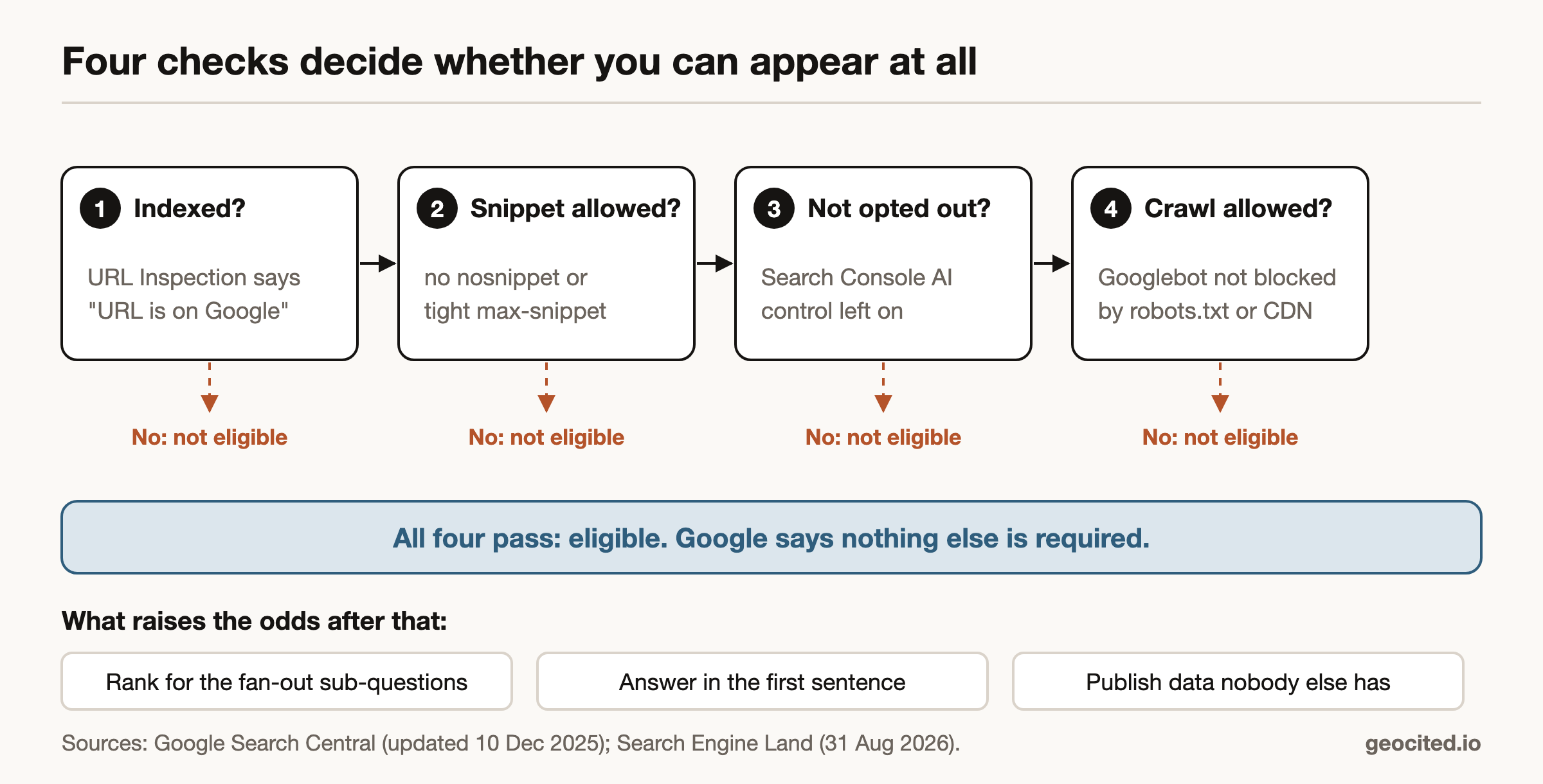
Google's documentation is short and specific. To appear as a supporting link in AI Overviews or AI Mode, a page must be "indexed and eligible to be shown in Google Search with a snippet." It then adds: "There are no additional requirements to appear in AI Overviews or AI Mode, nor other special optimizations necessary." You do not need to create "new machine readable files, AI text files, or markup," and there is no special schema.org structured data to add (Google Search Central, "AI features and your website," updated Dec 10, 2025).
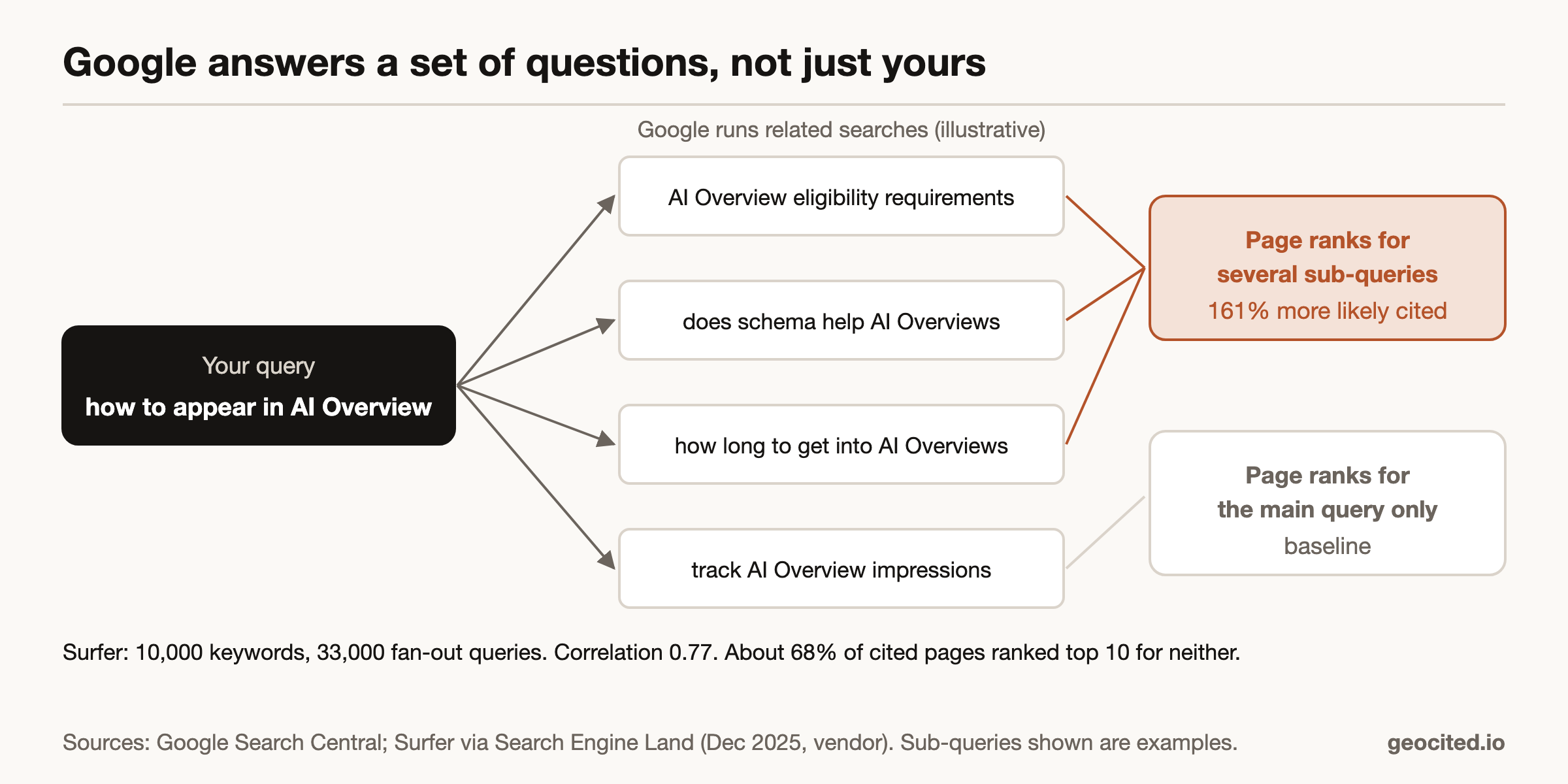
The same page names the mechanism. AI Overviews and AI Mode use a "query fan-out" technique, running several related searches across subtopics before writing the answer. That detail matters more than anything else on the page, and we come back to it below.
Four things can keep an otherwise good page out:
- Not indexed. If Google has not indexed the URL, nothing else matters.
- Snippet controls.
nosnippet,data-nosnippetandmax-snippetlimit what Google can show, and Google lists them as the controls that also limit AI features.noindexremoves the page entirely. - The new Search Console switch. On 31 August 2026, Google rolled out a control in Search Console, worldwide, that lets a site opt out of its generative AI features. Google says "sites that opt out will not receive traffic or impressions from our generative AI features" (Search Engine Land, Aug 31, 2026). If someone on your team flipped it, you will not appear, however good the page is.
- Blocked crawlers. A robots.txt rule or firewall that blocks Googlebot does the same thing. Cloudflare changed its default AI crawler settings on 15 September. Search crawlers stay allowed by default, but check any block rules you set yourself (details in our Cloudflare post).
How Google picks the pages it cites
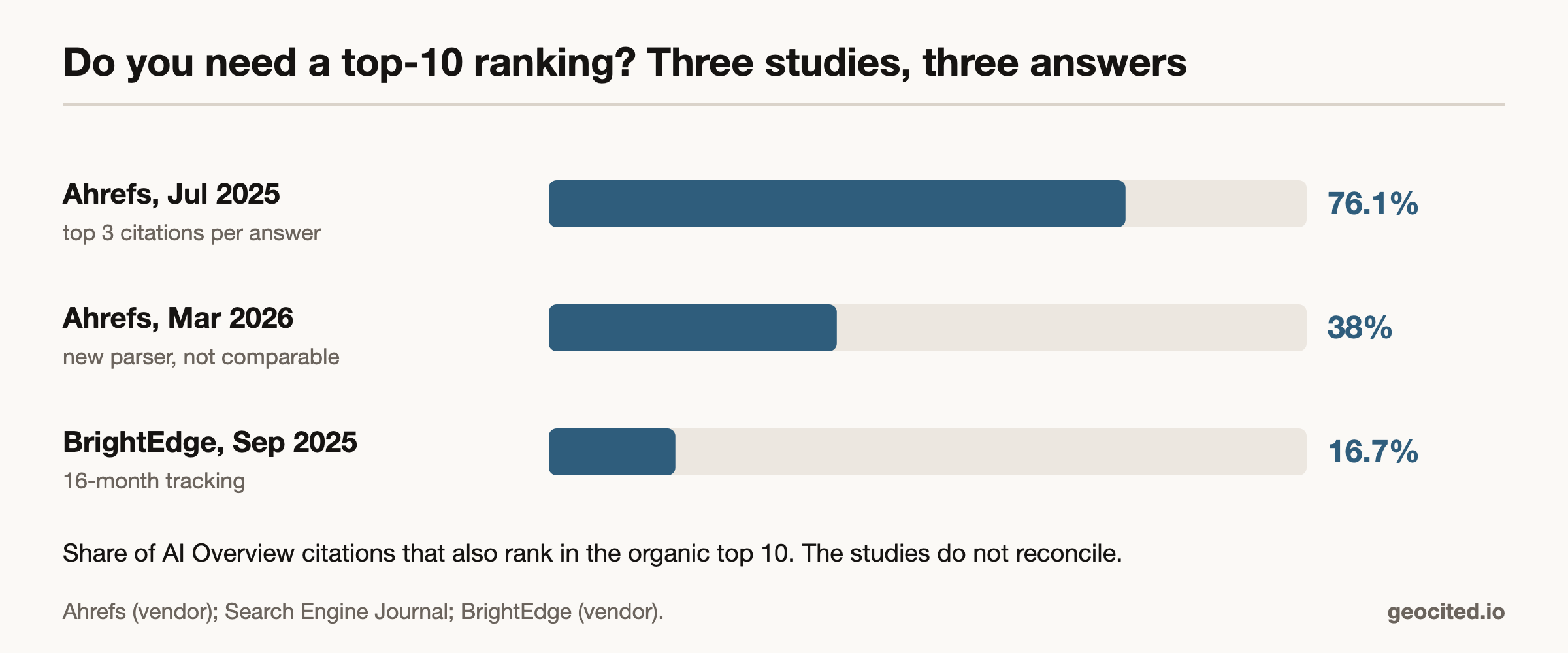
Because AI Overviews fan out into several searches, the pages cited are not simply the top results for the query you typed. How closely citations follow the normal rankings is disputed, and the three best-known measurements disagree:
| Study | Data | Share of AI Overview citations from the top 10 organic results |
|---|---|---|
| Ahrefs, Jul 21, 2025 (vendor-funded) | 1.9 million citations from 1 million AI Overviews, top three citations per answer | 76.1% |
| Ahrefs, via Search Engine Journal, Mar 2, 2026 (vendor-funded) | 863,000 keywords, 4 million AI Overview URLs | 38% |
| BrightEdge, Sep 18, 2025 (vendor-funded) | 16 months of tracking, May 2024 to Sep 2025 | 16.7% (54.5% ranked somewhere organically) |
Sources: Ahrefs, Search Engine Journal, BrightEdge.
These do not reconcile. Ahrefs says its parsing improved between its two studies, so they cannot be compared directly, and BrightEdge counts citations differently. What all three agree on is that ranking in the top 10 for your exact query is neither required nor enough.
The fan-out explanation has the best supporting data. Surfer analysed 10,000 keywords, 173,902 URLs and 33,000 fan-out queries, and found that pages ranking for the fan-out queries were 161% more likely to be cited than pages ranking only for the main query, with a Spearman correlation of 0.77 (Search Engine Land, Dec 18, 2025, vendor-funded). Surfer's own caveat: about 68% of cited pages ranked in the top 10 for neither the main query nor the fan-out queries, so ranking still does not explain everything.
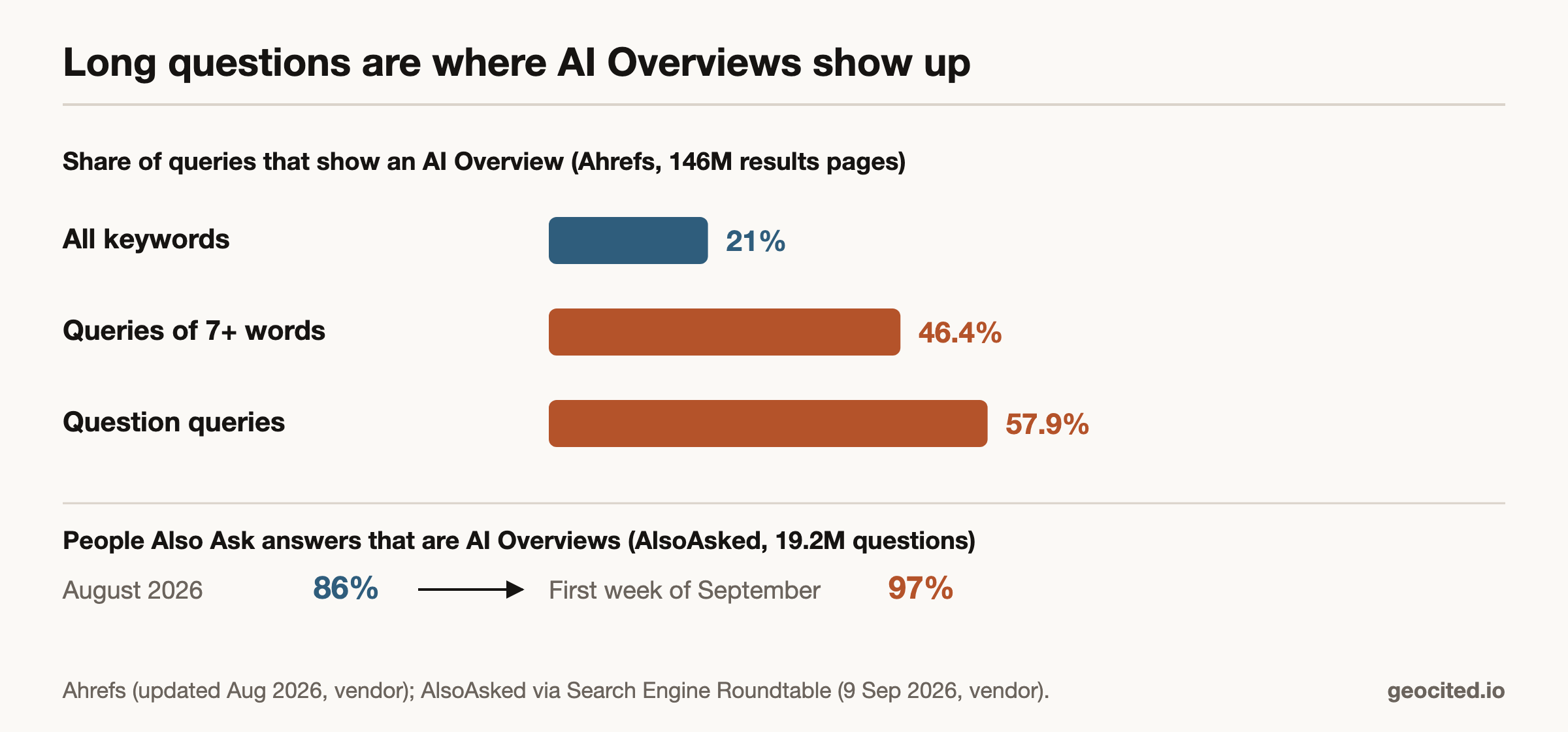
Which queries get an AI Overview at all also varies by shape. Ahrefs, across 146 million results pages, found AI Overviews on 21% of keywords, rising to 57.9% for question queries and 46.4% for queries of seven words or more (Ahrefs, "How to Rank in AI Overviews," updated Aug 12, 2026, vendor-funded). Long, question-shaped searches are where the opportunity is. The People Also Ask box has become part of the same system: AlsoAsked, which sells a People Also Ask research tool, found that 97% of PAA answers in the first week of September 2026 were AI Overviews, up from 86% in August, across a sample of 19.2 million questions (Search Engine Roundtable, Sep 9, 2026).
Our test: a brand-new page in the AI Overview within a day
On 29 August 2026 we published an original study on geocited.io: Which Content Formats Win the Most AI Citations for B2B SaaS? It tested 40 buying-intent prompts on ChatGPT and Google and classified 490 cited URLs.
The domain was a poor starting point, according to Search Console and Ahrefs on 30 August:
| Signal | Value |
|---|---|
| Referring domains (Ahrefs) | 7 |
| External links (Search Console) | 1 |
| Indexed pages | 19 |
| Indexed blog articles before this one | 0 of 16 |
| Indexed history | under two months |
What happened next, from Search Console and live searches:
| When | What happened |
|---|---|
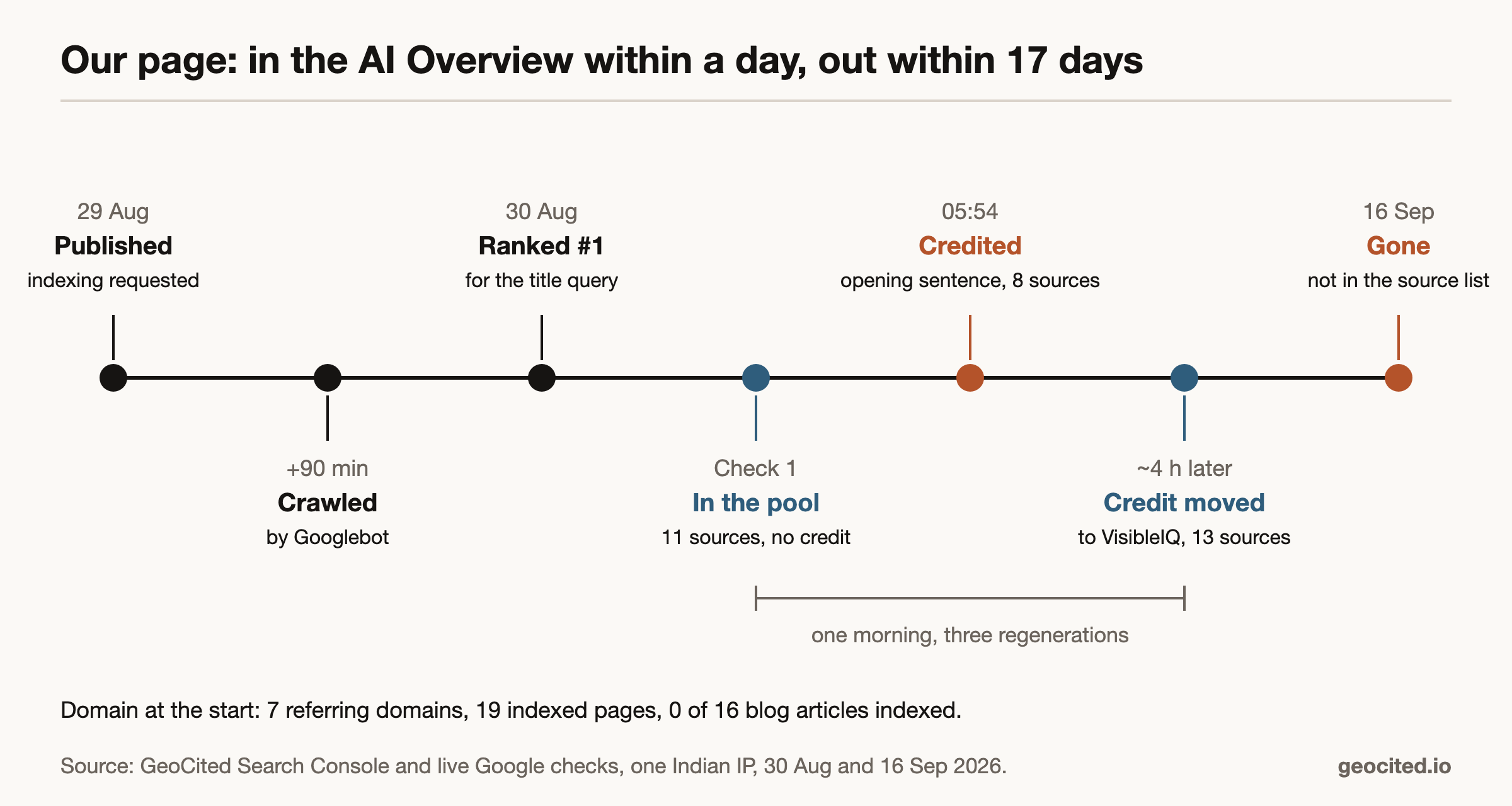
| 29 Aug | Published. Indexing requested through Search Console URL Inspection |
| 29 Aug, 17:11 | Googlebot crawled the page, about 90 minutes after the request |
| 30 Aug, morning | Indexed. First position for the exact title query, above HubSpot, Foundation Inc and Neil Patel |
| 30 Aug, first check | AI Overview with 11 sources. geocited.io in the pool, grounding no sentence |
| 30 Aug, 05:54 | AI Overview regenerated with 8 sources. geocited.io grounded the opening sentence, which now used our thesis ("because they match explicit user intent") and a figure of "over 40% to 56%" for comparison pages (ours was 56.7%) |
| 30 Aug, about 4 hours later | Regenerated again with 13 sources. The opening line was close to our finding word for word, but its citation now pointed to VisibleIQ. geocited.io stayed in the pool without a visible citation |
The full record, with screenshots and limits, is in our 48-hour case study.
We changed four things at once, so we cannot separate their effects. In the order we would rank them:
- Original data. The page had numbers that existed nowhere else.
- A direct answer first. One bold sentence answered the title before any introduction. That was the sentence Google cited.
- The title was the query. The exact string a person types, in the title, the H1 and the URL slug.
- Published method and limits. Raw data, the classifier script, and a list of what we could not verify.
What we did not have: backlinks worth mentioning, domain authority, age, or volume. The page did carry JSON-LD schema, and we do not credit it (see below).
What we saw 17 days later
On 16 September 2026 we ran the same query again from the same profile.
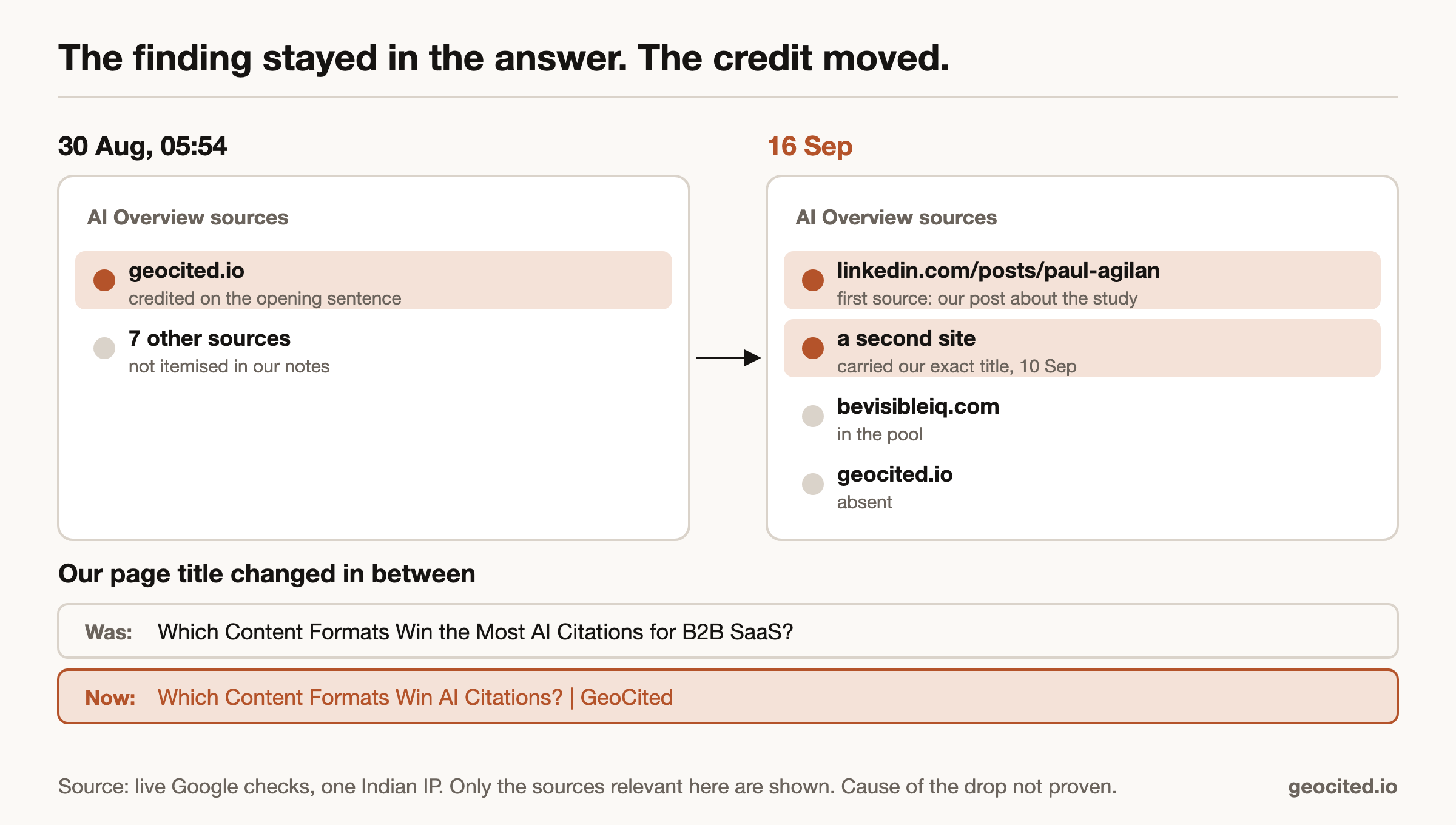
With Indian results, an AI Overview appeared. geocited.io was not in its source list and not among the organic results we captured. The opening line had moved to "Listicles, comparison pages, and structured technical documentation," and the answer still carried a figure of "40% to 57%" for comparison pages on head-to-head queries. The first source in the panel was a LinkedIn post by our founder announcing the study. Another cited source was a page dated 10 September carrying our article's exact title. We could not load that page to check what it contains.
With US settings (gl=us), no AI Overview appeared, and geocited.io was not in the top results. The founder's LinkedIn post ranked second.
Our page was still indexed; a site: search returned it. But its title had changed. It now reads "Which Content Formats Win AI Citations? | GeoCited," which no longer matches the query, and "for B2B SaaS" is gone. We have not proven that this caused the drop. It is the one change to the page we know about, and it removes the third of the four decisions above.
Three lessons from the second look:
- The finding survived; the credit moved. Google kept the 40% to 57% figure and the documentation point but credited them to a LinkedIn post and another domain. Original data spreads, and whoever restates it can take the citation.
- A citation is not a position you hold. SISTRIX measured only 5% weekly turnover in the domains Google AI Overviews cite, far steadier than ChatGPT's 74% (SISTRIX, May 1, 2026, vendor-funded). We still watched one answer regenerate three times in a morning and lose us within three weeks. Averages hide what happens to a single new page.
- Distribution counts. The LinkedIn post that now gets cited was written to promote the study. It became a source in its own right.
How to appear in Google AI Overview: the steps
- Confirm you are eligible. Check URL Inspection in Search Console: the page should be indexed, with no
nosnippetor restrictivemax-snippet. Check that your site has not opted out of generative AI features in Search Console, and that Googlebot is not blocked in robots.txt or your CDN. - Fix crawl problems first. Use one host (www or not), one trailing-slash convention, 301 redirects for old URLs, and a sitemap generated from your live routes. On our domain, duplicate hosts and paths were why 15 of 16 articles sat unindexed. Our technical checklist has the full list.
- Put the exact question in the title, H1 and slug, and keep it there. Use the words people type, not your category term. Treat later title edits as a ranking change, because ours may have been one.
- Answer in the first sentence. Put a 40 to 70 word answer directly under the H1 that makes sense on its own. It is the unit Google lifts.
- Answer the questions behind the question. Google fans a query out into subtopics. Give each likely sub-question its own heading and a direct answer, so the page can rank for the fan-out searches as well as the main one.
- Publish something only you have. A test you ran, numbers you collected, a dataset you built. If a page restates other people's studies, Google has no reason to cite it over them.
- Get the finding repeated where Google already looks. Our LinkedIn post became a cited source. Ahrefs reports YouTube as the domain AI Overviews cite most often, and brand mentions as the factor most strongly correlated with AI Overview visibility across 76.7 million AI Overviews (Ahrefs, vendor-funded, correlation only). Publish the finding on your own site first, then restate it on the platforms you use, linking back.
- Request indexing for the first page. URL Inspection got our page crawled in 90 minutes. It is capped to a handful of requests a day, so internal links from indexed pages have to do the rest.
- Measure repeatedly, not once. Search Console's generative AI performance report shows how often your links appeared in AI Overviews and AI Mode. It counts impressions only, with no clicks (Search Console Help). Ours showed 37 impressions in the three months to 8 September 2026. Pair it with repeated manual checks of your target queries, dated, and never rely on one screenshot.
What does not help
Schema markup. Ahrefs tracked 1,885 pages that added JSON-LD, against 4,000 matched controls, and found a statistically significant 4.6% drop in Google AI Overview citations, with no significant effect on AI Mode or ChatGPT (Ahrefs, May 11, 2026, vendor-funded). The authors note the pages studied were already heavily cited, so it does not settle whether schema helps a page get its first citation. Google's documentation says no special schema is needed.
Length. Ahrefs found 53.4% of pages cited in AI Overviews are under 1,000 words, and a correlation of 0.04 between word count and citation position (Ahrefs, Dec 3, 2025, vendor-funded). Write as long as the question needs.
AI text files. Google says outright that you do not need "new machine readable files, AI text files, or markup."
Backlinks, in our case. Our page got in with seven referring domains. That is one page on a long-tail query. It does not show that links never matter, and on competitive head terms they almost certainly do.
Sources
- AI features and your website, updated Dec 10, 2025 — Google Search Central — https://developers.google.com/search/docs/appearance/ai-features
- Generative AI performance report (Search), accessed 16 Sep 2026 — Search Console Help — https://support.google.com/webmasters/answer/16984139?hl=en
- Google Search Console AI performance reports and Search generative AI control rolling out globally, Aug 31, 2026 — Search Engine Land — https://searchengineland.com/google-search-console-ai-performance-reports-and-search-generative-ai-control-rolling-out-globally-486269
- AI Overview citations and search rankings, Jul 21, 2025 (vendor-funded) — Ahrefs — https://ahrefs.com/blog/search-rankings-ai-citations
- Google AI Overview citations from top-ranking pages drop sharply, Mar 2, 2026 — Search Engine Journal — https://www.searchenginejournal.com/google-ai-overview-citations-from-top-ranking-pages-drop-sharply/568637/
- Rank overlap after 16 months of AI Overviews, Sep 18, 2025 (vendor-funded) — BrightEdge — https://www.brightedge.com/resources/weekly-ai-search-insights/rank-overlap-after-16-months-of-aio
- AI Overview fan-out rankings boost citation odds by 161%, Dec 18, 2025 (Surfer data, vendor-funded) — Search Engine Land — https://searchengineland.com/ai-overview-fan-out-rankings-boost-citation-odds-study-466426
- How to Rank in AI Overviews, updated Aug 12, 2026 (vendor-funded) — Ahrefs — https://ahrefs.com/blog/how-to-rank-in-ai-overviews/
- Almost all People Also Ask results are Google AI Overviews, Sep 9, 2026 (AlsoAsked data, vendor-funded) — Search Engine Roundtable — https://www.seroundtable.com/ppa-ai-overviews-google-42047.html
- We Tracked 1,885 Pages Adding Schema, May 11, 2026 (vendor-funded) — Ahrefs — https://ahrefs.com/blog/schema-ai-citations/
- Short vs. Long Content in AI Overviews, Dec 3, 2025 (vendor-funded) — Ahrefs — https://ahrefs.com/blog/short-vs-long-content-in-ai-overviews/
- AI Citation Drift, May 1, 2026 (vendor-funded) — SISTRIX — https://www.sistrix.com/blog/ai-citation-drift-how-stable-are-sources-in-ai-search-results/
- How a brand-new domain with 7 backlinks reached Google's AI Overview in under 48 hours, Aug 30, 2026 — GeoCited — /case-studies/new-domain-google-ai-overview-48-hours
- Which Content Formats Win the Most AI Citations for B2B SaaS?, Aug 29, 2026 — GeoCited — /blog/which-content-formats-win-ai-citations-b2b-saas
- GeoCited Search Console and live Google checks, 30 Aug and 16 Sep 2026 — GeoCited (own data)
Frequently asked
What do I need to appear in Google AI Overview?
Your page must be indexed and eligible to show a snippet in Google Search. Google says there are no other requirements and no special optimization, files or schema. In practice, pages that rank for the related questions Google searches behind the scenes are cited far more often.
How long does it take to appear in an AI Overview?
It can be fast. Our page was crawled 90 minutes after we requested indexing, ranked first the next morning, and entered the AI Overview source list the same day. That was a low-competition query on a new page, so treat it as a best case.
Does schema markup help you appear in AI Overviews?
The best available evidence says no. Ahrefs' matched-control study of 1,885 pages found a small but statistically significant negative effect on AI Overview citations, and Google's documentation says no special schema is needed.
Do I need to rank in the top 10 to be cited in an AI Overview?
Not necessarily. Studies put the share of citations from top-10 pages anywhere from 16.7% to 76.1%, depending on method and date. Ranking for the fan-out sub-queries appears to matter more than ranking for the main query alone.
Why did my page disappear from an AI Overview?
AI Overviews regenerate, and the sources change. Ours dropped out within 17 days, after its title stopped matching the query and after other pages restated its finding. Check that your title, indexing and snippet settings have not changed before assuming anything else.
How do I track AI Overview appearances?
Use the generative AI performance report in Google Search Console, available worldwide since 31 August 2026. It shows impressions in AI Overviews and AI Mode but not clicks. Add dated manual checks of your key queries.
Can I stop my site from appearing in AI Overviews?
Yes. Search Console now has a control to opt a site out of Google's generative AI features, and `nosnippet`, `data-nosnippet`, `max-snippet` and `noindex` still apply. Google says opted-out sites get no traffic or impressions from those features.
Written by

Lourdes Paul Agilan runs GeoCited, a generative engine optimization agency. He works with B2B companies on how AI assistants describe and recommend them. He writes about that work here, and shares the experiments behind it. The tests that worked, and the tests that did not, written up the same way.